Our story
Why we made this
I'm Franki. My wife is Connie. We have been trying to have a child for more than four years.
Four years of dates in a calendar, of appointments, of two-week waits. Naturally at first, then IVF. You get good at a particular kind of patience - the kind where you hold hope and disappointment in the same hand and carry on with your Tuesday.
It is a quiet thing to go through. There is no announcement, no casserole, no one asking how you are doing. Just the two of us, and a lot of energy with nowhere to put it.
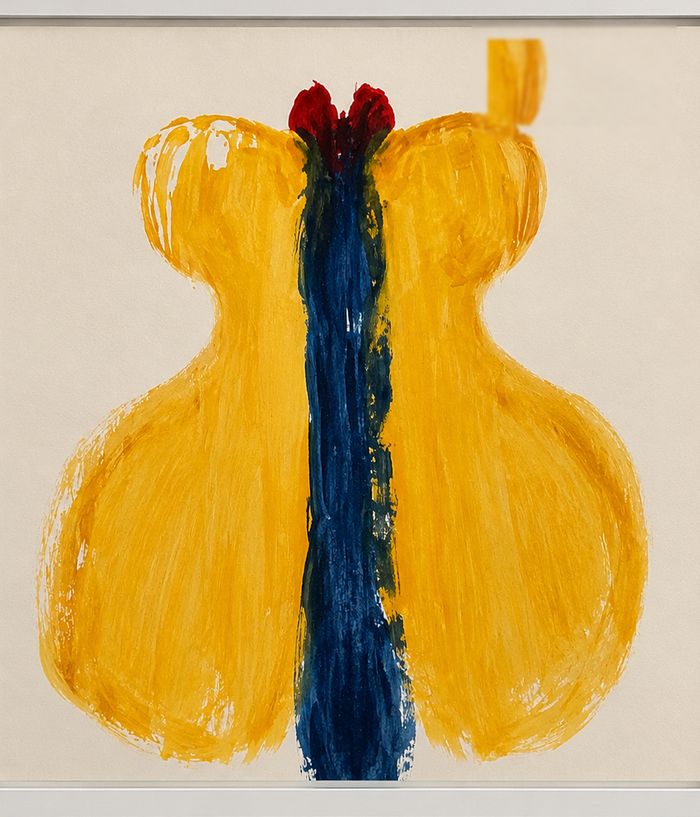
There is a painting on our kitchen wall - a yellow butterfly. My niece made it when she was two or three, and it was the first present she ever gave me. Connie framed it and hung it where we eat breakfast, so it is the first thing we see every morning.
I would look at it and something would lift. I started wondering what a song for the child who painted that would sound like.
That became the first single.
There's a line I keep coming back to - on the darkest nights, the brightest stars shine.
Then I started thinking about songs as a way to channel all of it. A way to have a child in our home, in a strange way, through music. Not instead of one. We are still going with IVF. But alongside it - something that brings the joy in now rather than later.
So that is what this is. Twelve songs about twelve animals, for children who are nought to six, built to be sung badly in a kitchen at eight in the morning. The same kitchen, as it happens, with the butterfly on the wall.
Where Alex came from
Alex began with my nieces and the small children I have watched grow up with their hearts wide open - hopeful, loud, unembarrassed and delighted by a stick.
The afternoons we spent painting and singing and playing nothing in particular: that is what Alex is made of. Not a character I designed, so much as a feeling I was trying to keep hold of.
Alex is now officially a girl: brown hair in two pigtails, blue dungarees, a yellow shirt and a yellow ukulele. She is still made for every child who wants to step through the door and join the adventure.
How the songs are made
Every lyric, hook, action and character choice starts with a person. I write the words, test the rhythm aloud and shape the world; AI tools help create the recordings and clay-style pictures around that work.