Practises following two-step instructions
Halfway through, the song stops and asks: can you stomp like a bear? Can you stretch like a bear? The same skill as “shoes on, then bag”, just with nobody nagging.
Australian action songs for ages 0-6
Original songs for little listeners, built around one animal, one movement and one joyful invitation to join in.
♪ About three minutes each. Just long enough for a proper stomp.Choose an adventure
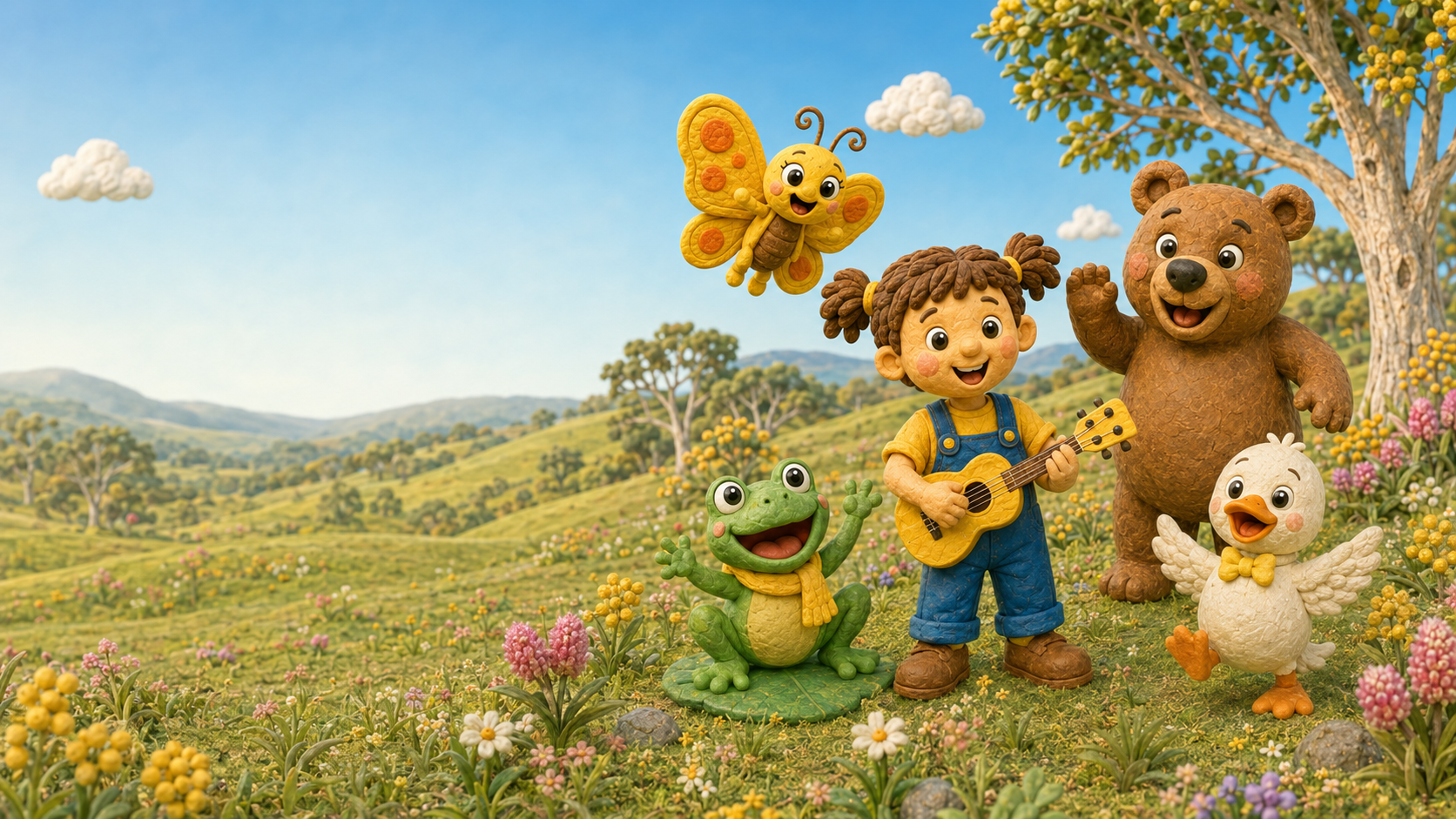
Meet the clay characters already stepping, splashing, flapping and scurrying through the Yellow Door.
| # | Song | Action | Status | |
|---|---|---|---|---|
| 01 | Wiggle Waggle Yellow Butterfly | Flap | Open now | ▶ Watch |
| 02 | Big Blue Whale | Splash | Open now | ▶ Watch |
| 03 | Sleepy Purple Owl | Swoop | Open now | ▶ Watch |
| 04 | Little White Duckling | Quack | Open now | ▶ Watch |
| 05 | Big Brown Bear | Stomp | Open now | ▶ Watch |
| 06 | Little Red Ladybird | Crawl | Open now | ▶ Watch |
| 07 | Little Pink Piglet | Trot | Open now | ▶ Watch |
| 08 | Little Grey Mouse | Scurry | Open now | ▶ Watch |
| 09 | Little Green Frog | Hop | Open now | ▶ Watch |
| 10 | Little Orange Fish | Flip | Open now | ▶ Watch |
| 11 | Little Black Puppy | Bark | Open now | ▶ Watch |
| 12 | Little Golden Bee | Zoom | Open now | ▶ Watch |
Big Brown Bear, Little Green Frog, Little Orange Fish. Big movements, whole body, best before you need them to sit still.
Wiggle Waggle Yellow Butterfly, Little White Duckling, Little Pink Piglet. Simple repeated words a toddler picks up in two listens.
Sleepy Purple Owl, Big Blue Whale. Slower, gentler, good before a nap or in the car.
Any of them. Each song runs about three minutes, needs no screen once it is playing, and the chorus repeats often enough that your child joins in without you.
More than three minutes of fun
They are playful first. Underneath the giggles, they are quietly practising useful things.
Halfway through, the song stops and asks: can you stomp like a bear? Can you stretch like a bear? The same skill as “shoes on, then bag”, just with nobody nagging.
The children on the recording answer first, so your child can join on the second go, the tenth go, or simply watch from the couch.
Rainy Sunday, small flat, the hour before dinner. Three minutes of stomping, hopping and flapping without another screen.
Pick one for pack-up time or the walk to the bath. After a week, the song does the asking instead of you.
Rhyme, alliteration and sound-play build phonological awareness, the groundwork children draw on later when they learn to read. These are songs, not a reading programme, but the groundwork is real.
Built to be remembered
Every line follows the same three-part move. Once you hear it, you cannot unhear it.
One hard syllable, one beat. Stomp, stomp, stomp. Slow enough that a two-year-old can land on it.
The line parks on one stressed syllable: big brown bear. Nothing trails off, so the tune stays up and the chorus is shoutable.
A fast, light run that spills out. Rumble-tumble. Twice the syllables, half the weight. Try to clap it and you cannot. That contrast is the joy.
Wiggle-waggle. Splishy-sploshy. Tick-tock. The vowel climbs and bounces, making hooks feel like words your child already knows.
Two albums, two kinds of wonder
Album one is about moving: stomp, splash, hop and flap. Album two, Wiggle Waggle Wonder Why, is about the questions that start arriving around three.
Can worms see? Do fish sleep? Can kangaroos hop backwards? Six of the twelve answers are no. Every no becomes a gentle “No, but they can…”
Same warm world, same memorable hooks, and a new reason to keep asking questions.
How they are made
AI helps build the music and pictures faster than one person could alone, and it is always clear when it is used.
Every lyric, hook, action, character and creative choice is written, said out loud, walked around the kitchen, and rewritten until a four-year-old can sing it back. The tools accelerate. The heart is not something they can supply.
Read the whole story →